Quick answer: Filigree jewelry is made from 925 sterling silver wire that is twisted, curled and soldered into lace-like openwork. For wholesale, verify it with three fast checks: (1) a loupe reveals clean solder joints and continuous wire; (2) the back side shows even finish with no burs; (3) consistent wire gauge and weight signal a real factory. Both handcrafted and machine-made can be genuine 925 — the difference is price and micro-variation, not authenticity.
Filigree is the canary of jewelry quality control. Nowhere else does a shortcut hide so easily: a single weak solder joint, a inconsistent wire, a sloppy back — none of it shows in a product photo, all of it shows in a returned order. We have run a silver filigree line since 1994, and the wholesalers who last are the ones who learned to verify in under a minute. This guide is that minute.
What Filigree Jewelry Actually Is
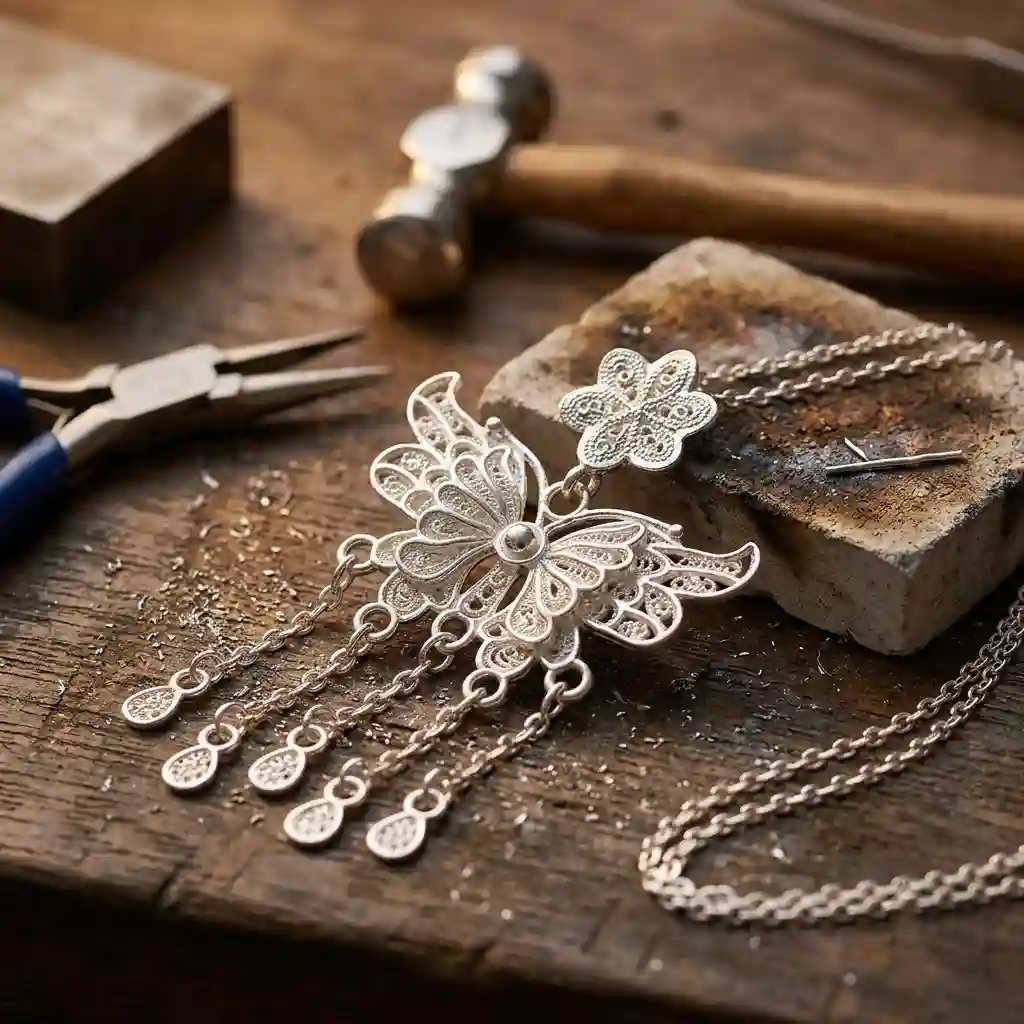
Filigree (from the Latin filum, “thread”) is jewelry built from fine metal wire — usually 925 sterling silver — that is drawn thin, twisted, curled, granulated and soldered into open, lace-like patterns. It is one of the oldest silversmithing techniques, with deep roots in Mediterranean, Indian, Mexican and Moroccan workshops. The “lace” look comes from openwork: the pattern is the negative space, not a solid plate. That is also why it is fragile if the wire or solder is substandard — there is no backup mass holding it together.
Artisan filigree craftsmanship process of the handmade butterfly pendant
Handcrafted vs Machine-Made — The Real Difference
The question wholesalers ask most — “is it handmade?” — is usually the wrong question. Both hand-twisted and machine-assisted filigree can be genuine 925 silver. The real differences:
Wire consistency: hand work has tiny, charming variations in twist tension; machine work is mechanically uniform. Neither is “fake.”
Solder points: hand pieces have more, smaller joints; machine pieces use fixtures and fewer, larger joins. A good factory does both well.
Symmetry: machine wins on perfect mirror symmetry; hand wins on organic flow. Market-dependent (see demand geography below).
Price: handcrafted commands 2–4× the labor cost. Paying handcrafted prices for machine work is the classic rip-off — verify before you pay.
The takeaway: buy the method that matches your margin and your customer, but never let “handmade” be the only proof of value. Authenticity is about the metal, not the technique.
The 925 Sterling Standard Still Applies
Filigree is only as good as its wire. Genuine pieces use 925 sterling silver (92.5% Ag + 7.5% Cu). Cheap “filigree” from some regions uses nickel-silver or brass wire with a silver wash — it tarnishes wrong, it irritates skin, and it fails EU REACH nickel rules. Require the millesimal mark (925/S925) and, for volume, an Silver Institute-consistent fineness spec. The FTC Jewelry Guides are explicit: “sterling” means 92.5% silver, full stop.
Handcrafted Filigree Silver Jewelry Front Profile View Premium 925 Sterling
How to Verify Filigree Wholesale Quality (30-Second Checks)
The 3-Second Loupe / Microscope Test
Grab a 10× loupe. Real filigree shows clean, rounded solder joints where wires meet, and continuous wire with no mid-span breaks or filler. Fakes show blobby solder, gaps bridged with glue, or wires that simply stop. If the “joint” glints like clear epoxy under light, it is adhesive, not solder — reject it.
The Back Side Never Lies
Flip it. The front is styled for the photo; the back is styled for the truth. A quality piece has an even finish, no sharp burs, no scorched spots from overheated solder, and (on antique finishes) a uniform oxidation, not patchy black. Burs = rushed polishing = a factory cutting corners you will feel in returns.
Wire Gauge & Weight Consistency
Measure wire diameter at several points with calipers; genuine 925 filigree holds a consistent gauge (e.g., 0.6–0.8 mm) across a run. Weigh ten identical pieces — they should match within a few percent. Wild weight spread means mixed metal lots or inconsistent wire, i.e., an uncontrolled line.
Inside the Factory — Three Decades of Hand-Twisted Wire
Our filigree process, so you know what “factory direct” should look like:
Handcrafted Filigree Silver Jewelry Close-Up Showing Authentic 5 to 15
Wire drawing — 925 rod drawn down to the target gauge, annealed for softness.
Twisting / shaping — wire twisted (single or double) and formed on jigs; hand pieces shaped freehand.
Oxidation / antique finish — controlled sulfur dip for the dark “vintage” look, then buffered.
Polish & QC — tumble + hand polish; XRF spot-check per lot; loupe every piece on bridal grades.
“Factory direct” should mean no trading middleman, a real MOQ you can start small on (we offer MOQ 1 for sampling, 3-7 day sampling turnaround), and a person who can describe the above without a script. If your supplier can’t, you are not buying direct.
Geometric vs Floral: The Geography of Demand
What sells where:
Mediterranean / Italian / Greek — geometric, symmetric, architectural filigree; strong in US and Southern Europe.
Mexican / Latin — bold floral and rosary filigree; high demand across Latin America and US Latino market.
Indian (jali) / Moroccan — dense floral and paisley openwork; growing in the desi and boho segments.
Bridal / Western — delicate scroll filigree on rings and halos; steady in US/EU engagement and wedding.
Stock the geometry that matches your destination market; mixing them is the fastest way to sit on dead inventory.
The Wholesale Buying Protocol — 7 Verification StFactory Direct Handcrafted Filigree Silver Jewelry Wholesale Production
eps
Sample first (MOQ 1–50) before any container.
Loupe every sample — joints, back, burs.
XRF or assay the metal — confirm 925, nickel ≈ 0.
Weigh & gauge a set; check consistency.
Confirm oxidation is even, not patchy.
Request certificate + mill trace per lot.
Audit the chain — can they show the bench? If not, pass.
Common Wholesale Mistakes
Paying “handmade” prices without verifying the method.
Assuming filigree = sterling (it often isn’t from unverified sources).
Ignoring the back side until returns arrive.
Skipping XRF to save a day — and buying nickel-silver.
Mismatching pattern geometry to the target market.
Frequently Asked Questions
Is filigree jewelry real silver?
It should be 925 sterling silver, but always verify — many low-cost “filigree” pieces use nickel-silver or brass with a silver wash. Check the 925 mark and confirm with XRF for volume.
Handcrafted-filigree-artisan-silver
How can you tell if filigree is handmade?
Look for slight, organic variation in wire twist and asymmetry; machine-made is mechanically uniform. But both can be genuine 925 — authenticity is about the metal, confirmed by XRF, not the technique.
Does filigree jewelry tarnish?
Yes, like all 925 silver, because of the copper content. Clean with a treated cloth; antique-finish pieces are deliberately darkened and need gentler care to protect the look.
Is filigree jewelry durable?
It is delicate by design (thin open wire), so it resists bending poorly if solder is weak. Quality 925 filigree with clean joints lasts for decades; verify joints before buying.
How is filigree jewelry made?
Silver wire is drawn thin, twisted and shaped, then soldered into open patterns, often given an antique oxidation finish, polished and QC-checked. Hand and machine versions follow the same metal rules.
Where should I buy filigree wholesale?
From a verified 925 factory that offers samples, XRF/assay proof, REACH nickel compliance and a traceable mill roll. Start with a small MOQ and audit the bench.
What does filigree mean in jewelry?
It means lace-like openwork built from fine twisted metal wire — “filigree” = thread-like. The pattern is the negative space, which is why wire and solder quality matter so much.