Pearls are making a comeback. Not the pearls your grandmother wore – the 2026 pearl market spans freshwater baroques, peacock Tahitians, lavender Chinese cultureds, and everything in between. For wholesale pearl jewelry buyers, the variety means there is a pearl for every customer budget. It also means you need to know what you are buying before you wire a deposit.
Understanding pearl grading – real versus imitation, freshwater versus saltwater, luster versus surface quality – saves money and prevents returns. Here is what fifteen years of sourcing wholesale pearl jewelry in Guangzhou teaches about stocking pearls that sell through rather than sit in inventory. Start with our 925 sterling silver standards – the setting matters as much as the pearl.
Real vs Fake: The First Filter in Wholesale Pearl Jewelry
The first skill every pearl buyer needs is distinguishing real pearls from imitations. Real pearls – natural and cultured – have a slight grit when rubbed gently against your teeth. Imitation pearls feel perfectly smooth because they are glass or plastic coated with a pearlescent paint. Real pearls have tiny surface irregularities that make each one unique. Under bright light, real pearls show subtle internal layers and depth. Fakes look uniformly perfect and plasticky – the uniformity that reads as “flawless” in a catalog photo is exactly what gives them away.
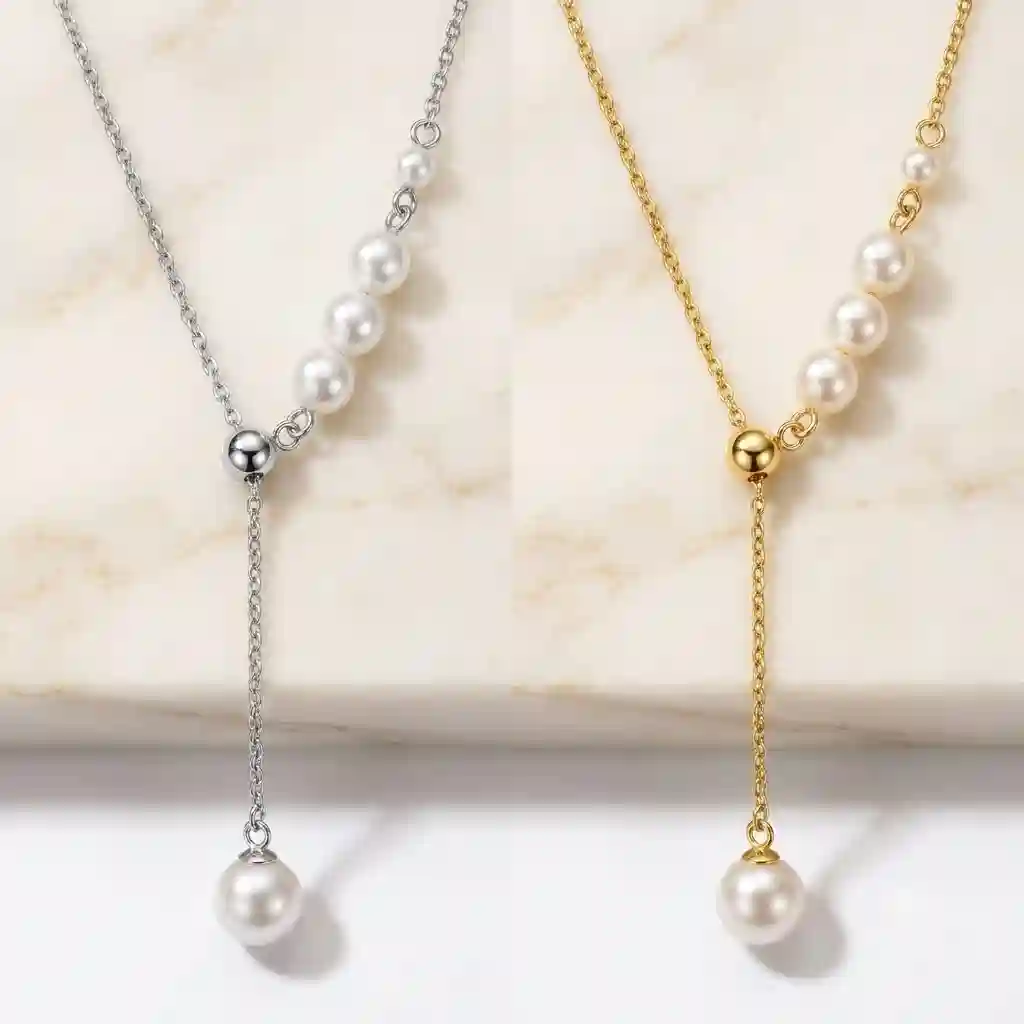
Pearl tassel Y-shaped necklace color comparison white gold gold 925 silver
Natural pearls form when an irritant enters an oyster in the wild. Cultured pearls are grown on farms with human intervention. Both are real pearls. The difference is origin, not authenticity. For wholesale pearl jewelry buyers, the distinction that matters is cultured versus imitation – nearly all commercial pearls today are cultured, and that is the category worth stocking. Imitation pearls have their place at the lowest price tier. They should never be sold as “pearls” without the word “imitation” attached. The FTC and EU consumer protection laws require disclosure. The customer who discovers they bought imitation sold as real does not return the piece – they charge back the transaction and leave a review that follows your store forever.
Freshwater vs Saltwater Pearls in Wholesale Pearl Jewelry
Freshwater pearls are grown in lakes and rivers, predominantly in China. They are the workhorses of wholesale pearl jewelry – affordable, abundant, and available in a wider range of natural colors than any saltwater variety. A freshwater pearl strand wholesales for roughly $8-30 depending on size and luster grade. They account for approximately 95% of cultured pearl production by volume because Chinese freshwater farms have mastered tissue-nucleation techniques that produce rounder pearls at higher yields than traditional bead-nucleation methods.
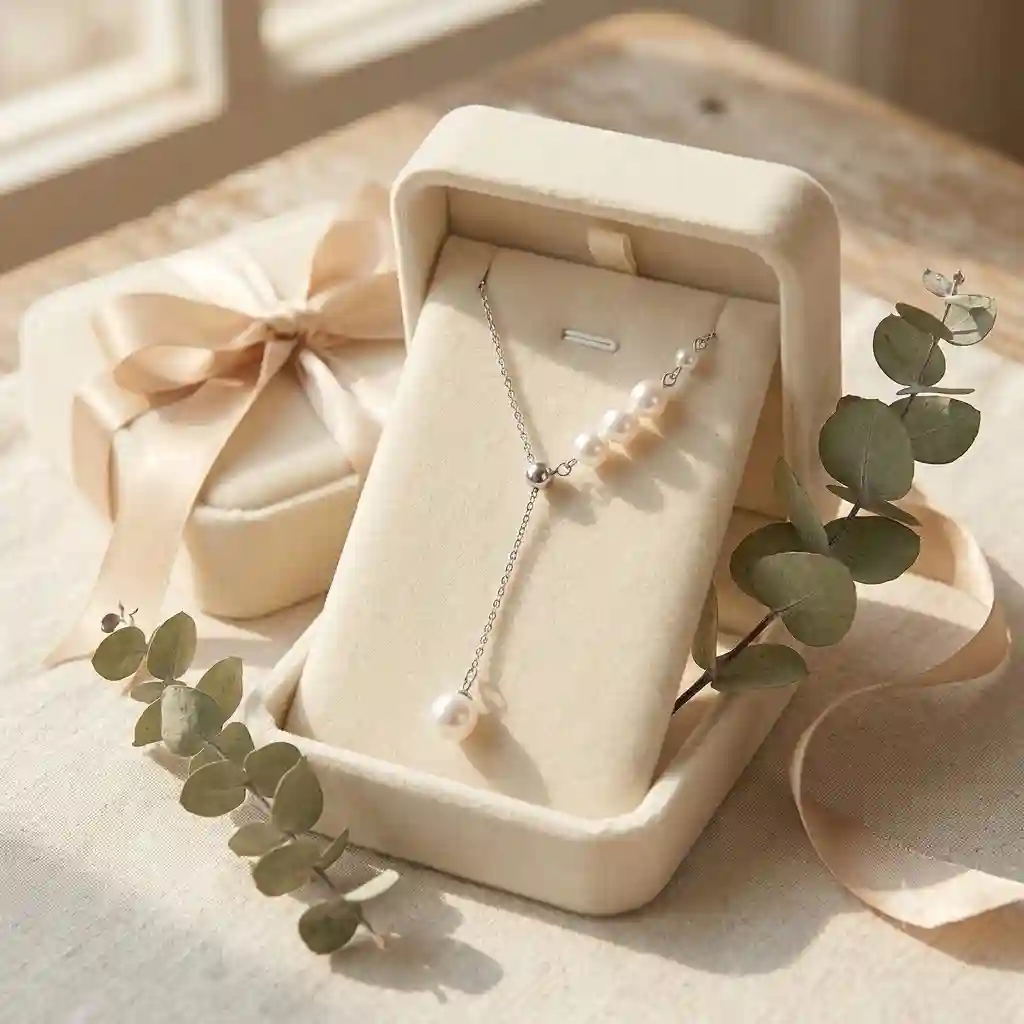
Pearl tassel Y-shaped necklace luxury gift packaging 925 silver jewelry gift
Saltwater pearls come from three main regions with distinct characteristics. Akoya pearls from Japan are the classic white round pearl – the image that appears in every jewelry advertisement since the 1950s. South Sea pearls from Australia and Indonesia are larger, typically 9-16mm, with a satiny luster that reads as luxury at arm’s length. Tahitian pearls from French Polynesia are known for their dark colors – peacock green, aubergine, charcoal, silver-blue – that command the highest per-pearl premiums in the current market. For everyday affordable wholesale pearl jewelry, freshwater is the foundation. For premium bridal pieces and high-end clients, Akoya and South Sea pearls justify their higher wholesale cost with visibly superior luster. Tahitian pearls occupy a niche where color is the differentiator – a strand of peacock Tahitians at $200-500 wholesale competes with merchandise five times the price on visual impact alone.
Pearl Shapes and Sizes: The Inventory Mix Strategy
Round pearls are the most valuable and traditionally sought-after shape. But baroque pearls – irregular, asymmetrical, organic forms – have become the breakout category in wholesale pearl jewelry for 2026. The fashion shift toward imperfect, natural-looking jewelry has elevated baroque from “second quality” to “designer aesthetic.” The wholesale price for baroque pearls runs 30-50% below round pearls of equivalent size and luster. The retail markup on baroque pearls runs higher than round because customers perceive baroque as “artistic” and “unique” rather than “cheaper.”
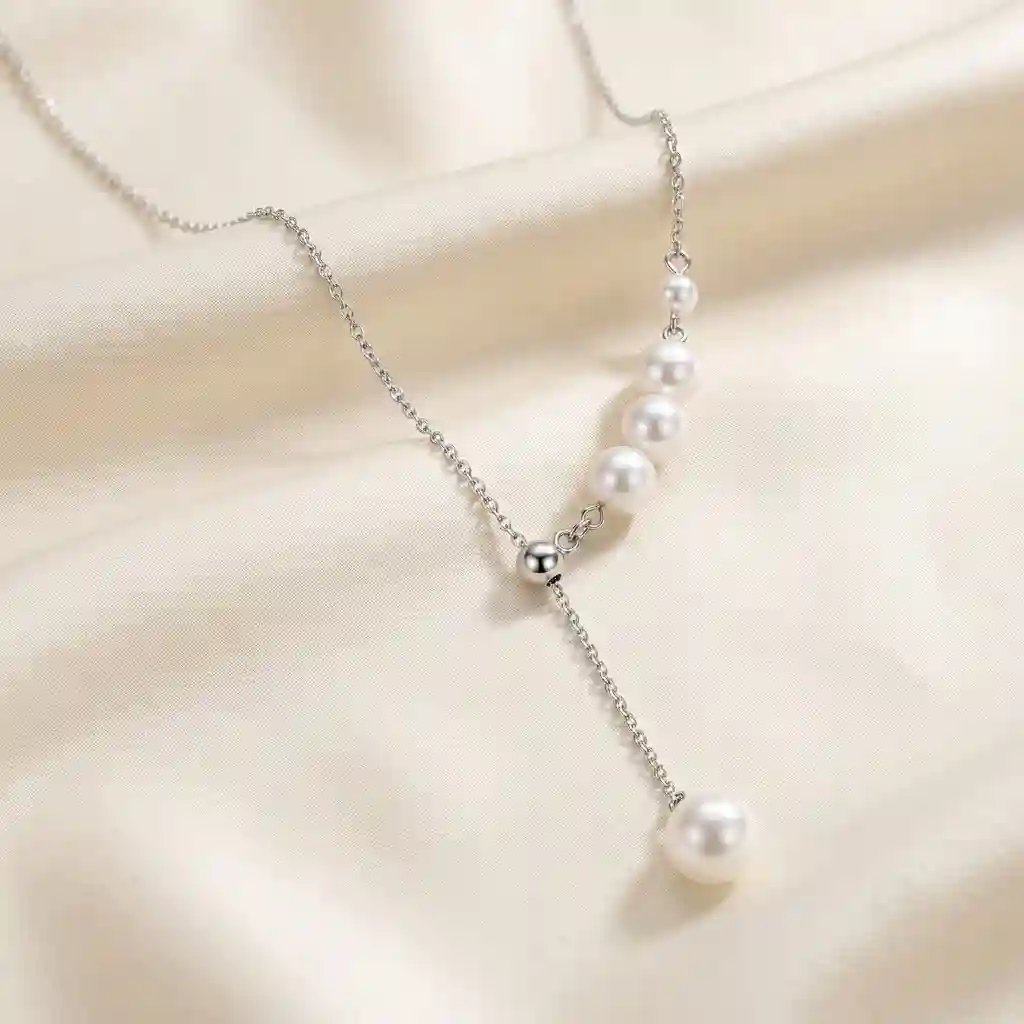
Pearl tassel Y-shaped necklace 925 silver asymmetric pearl chain Korean
Oval, teardrop, and button shapes offer variety at intermediate price points. Size drives price directly – larger pearls are exponentially rarer. An 8mm freshwater pearl wholesales for roughly double the price of a 6mm pearl of the same quality. A 10mm pearl costs roughly four times the price of a 6mm. For wholesale pearl jewelry inventory, stock a range from 6mm to 10mm. Smaller pearls in the 5-7mm range work for earrings and layered necklaces where the cumulative effect of multiple pearls matters more than individual size. Larger pearls in the 9-12mm range make statement pendants and solitaire rings. The safe ratio for a new wholesale pearl buyer: 60% in the 6-8mm range (earrings, everyday pendants), 25% in 8-10mm (classic strands, premium pendants), 15% in 10mm+ (statement pieces, bridal).
Sterling Silver Settings for Wholesale Pearl JewePearl tassel Y-shaped necklace worn asymmetric pearl chain 925 silver
lry
The best pearl jewelry uses genuine 925 sterling silver findings. Cheap base metal settings rust, flake, and discolor – destroying the presentation of even the finest pearl within months. Sterling silver complements the soft luster of pearls without overwhelming them visually. Rhodium-plated sterling adds protection against tarnish and keeps the metal bright through years of wear. Always check the hallmark on the clasp and findings – a deeply stamped 925, not a laser-etched mark that wears off. The GIA pearl grading guide is the standard reference for understanding pearl quality metrics – luster, surface, shape, color, nacre thickness. For nickel-free compliance required by European retailers stocking wholesale pearl jewelry, reference ECHA REACH nickel restrictions.
What to Stock: A Wholesale Pearl Jewelry Inventory Framework
Start with classic white freshwater pearl stud earrings and a simple strand necklace. These two items sell year-round across demographics and price points. They are the pearl equivalent of a white t-shirt – unglamorous inventory that pays the rent through consistent reorders while trend-driven pieces generate the margin.
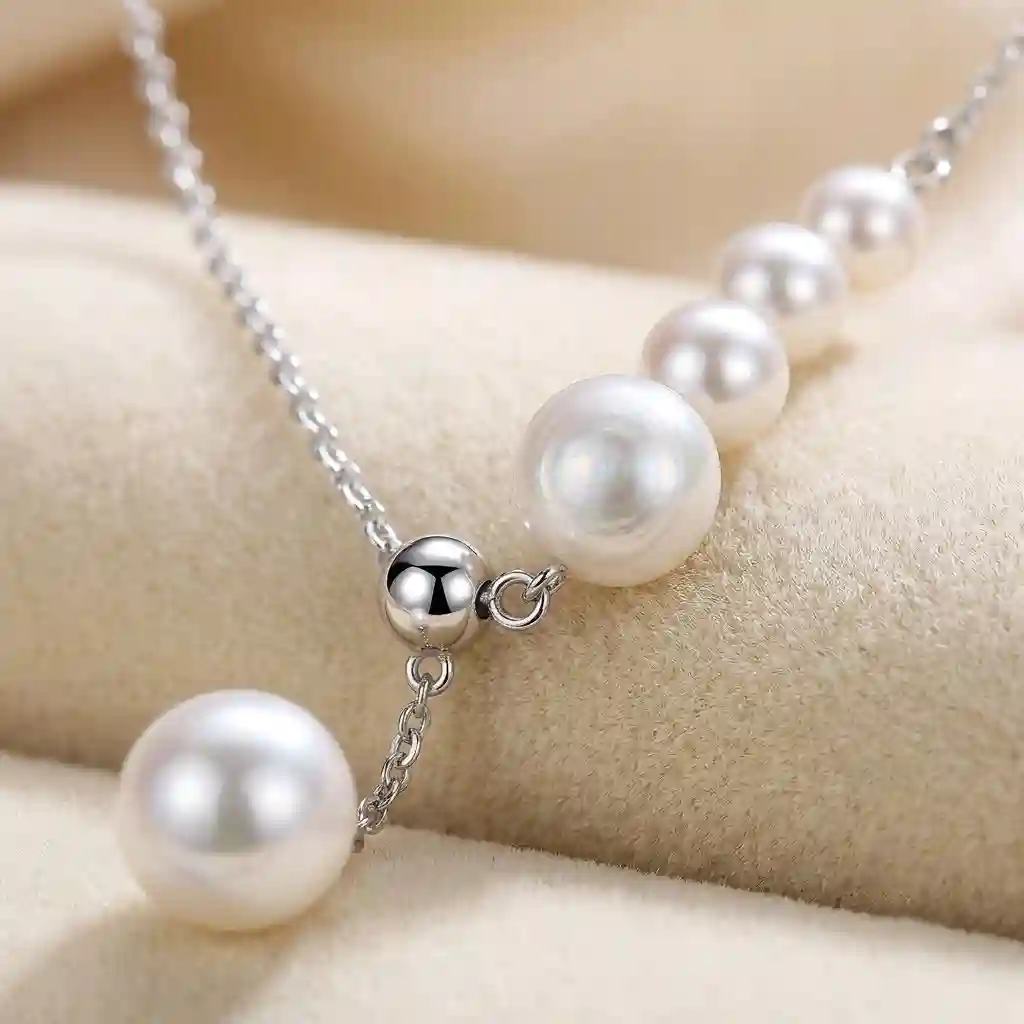
Pearl tassel Y-shaped necklace macro detail graduated pearls 925 silver
Add colored pearl pieces – pink, lavender, and peacock – for customers who want something beyond classic white. These natural colors occur in freshwater pearls through trace minerals in the water and the specific mollusk species, without dyeing or treatment. Pearl and gemstone combinations are trending in wholesale pearl jewelry for 2026 – a pearl pendant with a small gemstone accent offers visual contrast at a small cost increase. Stock both sterling silver and gold-plated findings to give retail customers options. Gold vermeil over silver – a thick layer of gold bonded to a sterling base – offers the gold look at a fraction of solid gold cost.
Pearl care is simple but mandatory to communicate. Store pearls separately from other jewelry to prevent scratching – pearl ranks only 2.5-4.5 on the Mohs hardness scale. Wipe with a soft cloth after wearing to remove skin oils and perfume residue. Avoid direct contact with chemicals, hairspray, and perfume – these substances dull the nacre over time. Never clean pearls in ultrasonic machines – the vibrations crack the nacre. Include these four care instructions with every wholesale pearl jewelry order. The five minutes it takes to print a care card prevents the return that costs eight dollars in shipping plus a lost customer. For factory-direct pearl pieces with batch documentation, see our full collection and transparent wholesale pricing.
The Verdict
Wholesale pearl jewelry in 2026 rewards buyers who understand the category beyond “white and round.” Freshwater pearls in baroque shapes and natural colors offer higher margin than traditional round whites because the market values them as design pieces rather than commodity strands. Saltwater pearls – Akoya, South Sea, Tahitian – occupy the premium tier where luster justifies price and color differentiation prevents comparison shopping. Imitation pearls belong at the budget tier with honest disclosure. Nickel-free 925 silver settings are the minimum standard for Western markets.
The inventory framework that works: 60% freshwater in the 6-8mm range for everyday earrings and pendants, 25% freshwater in 8-10mm for classic strands and premium pieces, 15% saltwater and statement pieces for bridal and high-end buyers. Stock white, pink, lavender, and peacock colorways. Include a care card with every order. The buyer who stocks pearls this way builds a category that sells year-round, resists price comparison, and generates the word-of-mouth that synthetic stones rarely produce. Browse our natural pearl and gemstone collection with disclosed origin and batch documentation.
About this analysis: This wholesale pearl jewelry guide is based on fifteen years of direct pearl sourcing experience in Guangzhou and Zhuji (China’s freshwater pearl capital), combined with verified Facebook Ads Library intelligence from Grand Bazaar Jewelers (four-generation Turkish manufacturer, “4 Generations, Always Handmade” since February 2026) and Zhefan Jewelry (operating since 1997, XRF-documented nickel-free compliance). Freshwater vs saltwater production volume statistics (95% freshwater by volume) sourced from China Pearl Association annual reports. Pearl grading standards – luster, surface quality, shape, color, nacre thickness – referenced from the GIA Pearl Grading Guide (gia.edu). Mohs hardness scale data for pearl (2.5-4.5) sourced from the GIA Gem Encyclopedia. Baroque pearl pricing differential (30-50% below round equivalents) derived from MIRAMETAL wholesale order data across multiple production batches (2020-2026). Nickel allergy prevalence and EU REACH nickel compliance requirements referenced from echa.europa.eu. FTC and EU consumer
MIRAMETAL
Elevate Your Collection with Wholesale Pearl Jewelry
Factory-direct 925 sterling silver jewelry, handcrafted for brands and boutiques worldwide.